
UV-C air disinfection for hospitals: a practical planning guide
Hospitals concentrate the highest density of infectious patients in a building type that never empties. That makes the two most common UV strategies — mobile UV robots and after-hours upper-room treatments — awkward fits: both assume a room you can clear. Sealed-chamber UV-C LED fixtures take the opposite approach, treating air continuously while the room stays in use.
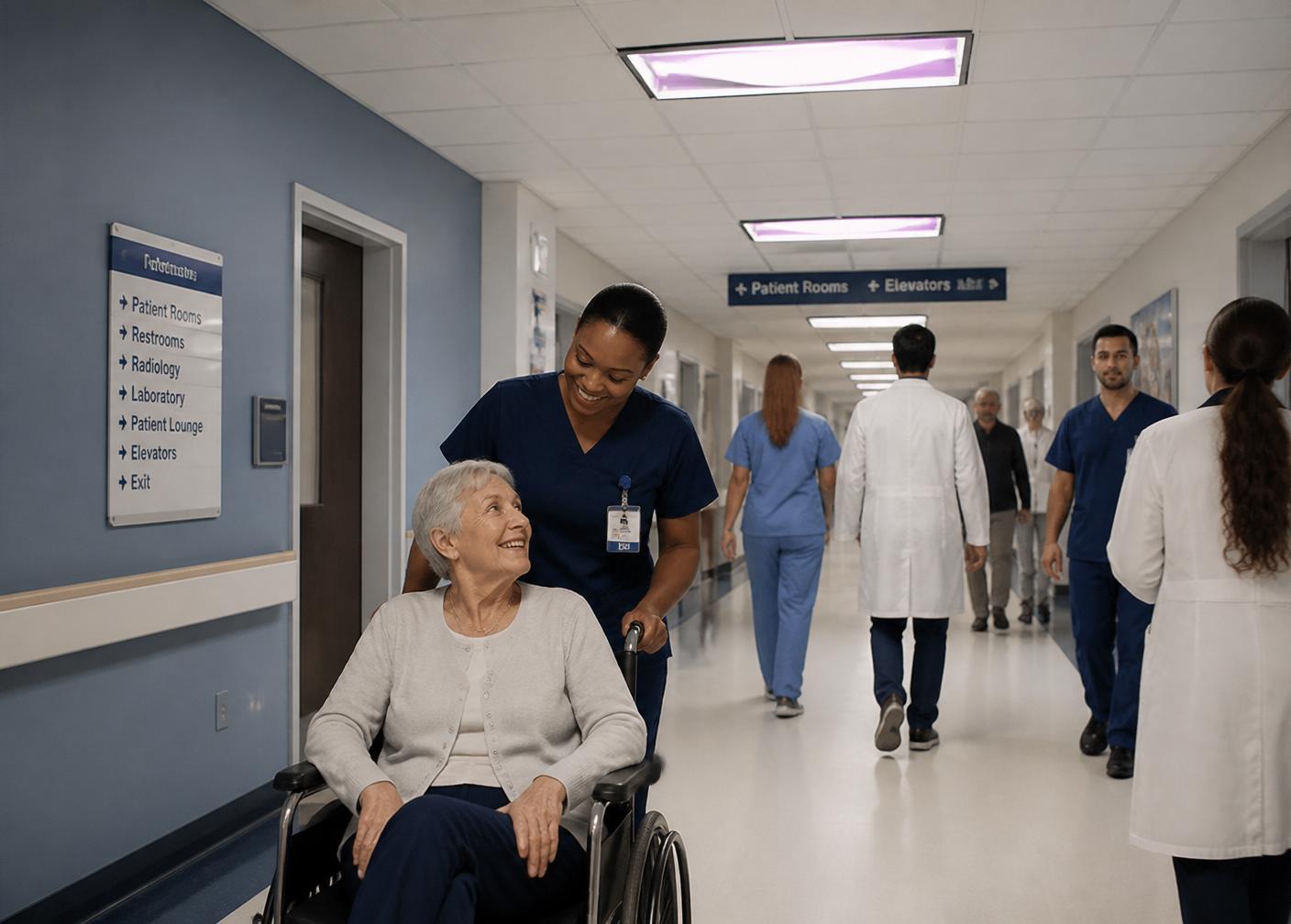
Why occupied-room air treatment matters in acute care
Airborne pathogens do not wait for terminal cleaning. Between HVAC cycles, room air is shared by patients, visitors, and staff for hours at a time. A fixture that only runs when a room is empty misses the window when transmission actually happens.
Because the UV-C LEDs sit inside a sealed internal chamber, germicidal light never contacts skin or eyes. Only treated air leaves the fixture — which is what makes 24/7 operation possible in an occupied patient room.
Room-by-room priorities
Most health systems phase deployment rather than doing a whole campus at once. A defensible order of operations puts the highest-dwell, highest-risk spaces first.
- Emergency department waiting and triage — undiagnosed patients, long dwell times
- Patient rooms — continuous overnight exposure; over-bed units target the breathing zone
- Pre-op, PACU, and recovery bays — immunocompromised and post-anesthesia patients
- Staff areas — break rooms and workstations where unmasked exposure clusters
- Corridors and elevator lobbies — wall sconces cover circulation space with no ceiling grid work
Sizing and coverage
Coverage is expressed in air changes per hour (ACH). The fixtures are designed to deliver 4–6 ACH in a typical room, which turns over the full air volume roughly every 10–15 minutes.
As a planning rule of thumb, start at approximately one fixture per 100 sq ft of floor area, then adjust upward for occupancy density and higher ceilings. Because 2×4 and 2×2 troffers match existing lay-in grid openings, the lighting layout you already have is usually close to the layout you need.
Facilities and infection-prevention questions to settle early
Two departments usually need to sign off. Facilities cares about installation disruption, circuiting, and long-term service; infection prevention cares about occupant safety and documented coverage.
- Which rooms are on the first phase, and what is the measurement plan for before/after
- Whether over-bed units or ceiling troffers fit each headwall configuration
- Fan noise expectations for sleeping rooms (fan speed is adjustable per space)
- Who monitors the maintenance-indicator light and on what interval
Key takeaways
- Sealed-chamber UV-C runs with patients present; robots and upper-room systems generally do not.
- Prioritize ED waiting, patient rooms, and PACU before general administrative space.
- Plan around 4–6 ACH and roughly one fixture per 100 sq ft, then adjust for density.
- Retrofits reuse the existing troffer openings, so most rooms need no construction.
Hospital UV-C Air Disinfection Planning Guide
A one-page planning sheet: room priorities, coverage math, and the questions facilities and infection prevention should settle before phase one.
- Room-by-room deployment priority list
- ACH and fixture-count worksheet
- Occupied-room safety explainer for infection prevention
- Comparison table: sealed-chamber UV-C vs. HEPA vs. UV robots
Frequently asked questions
Can UV-C air disinfection run while patients are in the room?
Yes, when the UV-C source is fully enclosed. In a sealed-chamber fixture the germicidal light never leaves the housing — room air is drawn in, treated at 275 nm, and returned clean — so the system runs continuously with occupants present.
How does this compare with a UV disinfection robot?
Robots irradiate surfaces in an empty room for a fixed cycle, then leave. Sealed-chamber fixtures treat air continuously, 24/7, and require no staff time per room. Many hospitals use both: robots for terminal surface cleaning, fixtures for ongoing airborne control.
Does UV-C inactivate COVID-19 and other airborne viruses?
UV-C in the 275 nm germicidal range damages the RNA and DNA of airborne pathogens — including coronaviruses such as SARS-CoV-2, plus bacteria, mold, and fungal spores — so they can no longer replicate as air passes through the chamber.