
Dental operatory aerosol control with UV-C: clearing air between patients
Ultrasonic scalers, high-speed handpieces, and air-water syringes all generate aerosols in a room the size of a walk-in closet. The standard mitigation — waiting for air to settle between patients — costs the one thing a practice cannot manufacture: chair time.
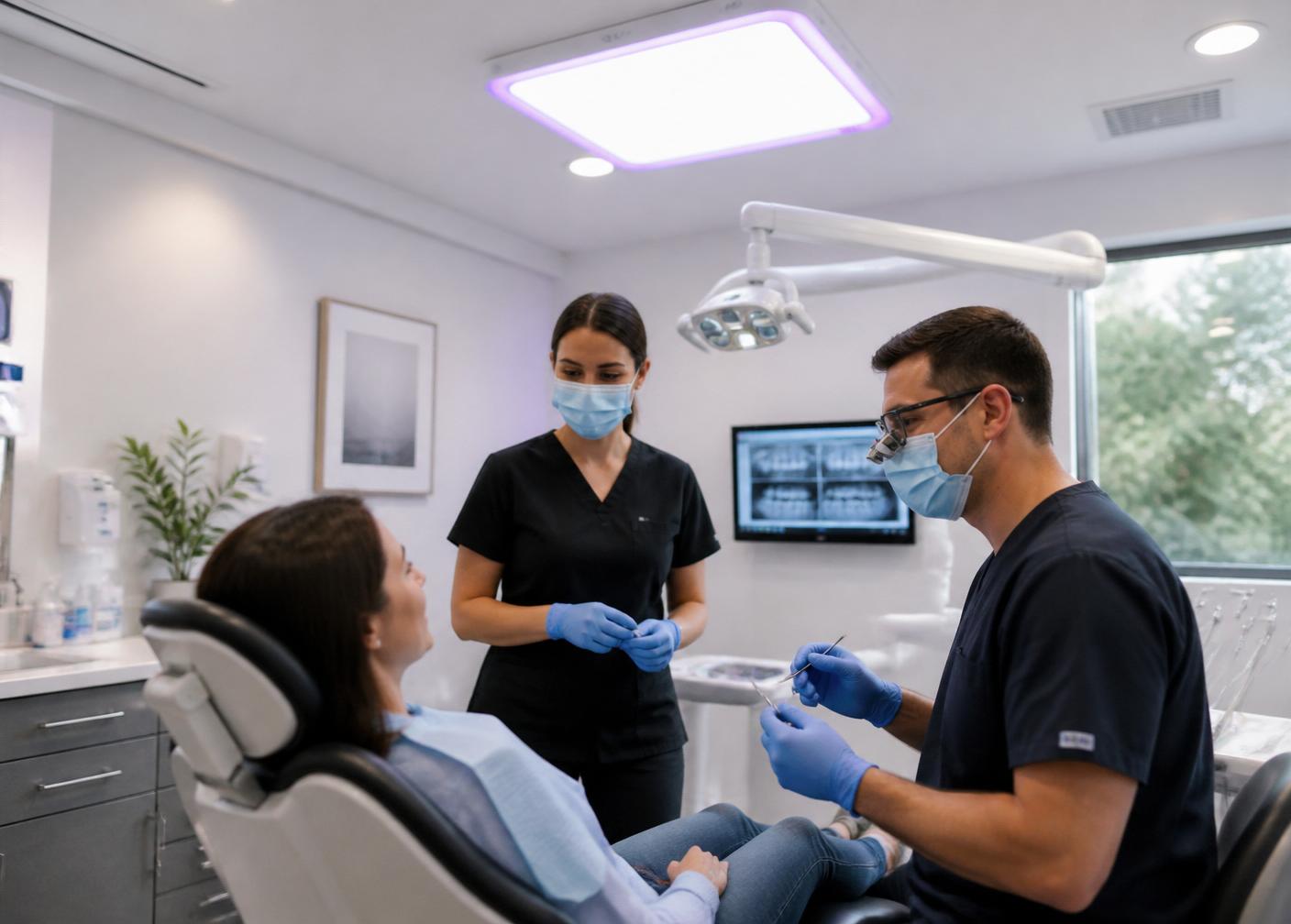
The turnover-time problem
Guidance for aerosol-generating procedures often implies a settle interval between patients, which in a small operatory with modest ventilation can consume a meaningful slice of every appointment slot. Multiply that across a full schedule and it becomes a capacity problem, not just a clinical one.
Continuous air treatment changes the arithmetic. If the room's air is already turning over every 10–15 minutes while you work, clearing does not start when the patient stands up.
What coverage looks like in a small treatment room
Operatories and exam rooms are small enough that one or two 2′×2′ UV-C troffers typically reach the 4–6 ACH design target. The compact form factor matters here: dense operatory ceilings rarely have room for a 2×4 opening over the chair.
For practices with hard-lid ceilings or plenum constraints, wall-mounted units cover the same volume without opening the ceiling.
Talking to patients about it
Air quality is now a visible trust signal in outpatient care, and patients ask. The explanation that works is short: the light above the chair pulls room air through a sealed chamber of UV-C LEDs and returns it clean, continuously, and no UV light ever reaches the room.
- Lead with 'continuously, while you're in the chair' — that is the differentiator
- Say the UV is fully enclosed; patients associate UV with skin and eye risk
- Skip claim inflation: describe what the system does, not infection rates you have not measured
Key takeaways
- Continuous treatment attacks aerosols during the procedure, not after it.
- One or two 2×2 fixtures typically cover an operatory at 4–6 ACH.
- Compact and wall-mounted options fit dense or hard-lid ceilings.
- Patient-facing messaging should emphasize the sealed, fully enclosed chamber.
Dental & Medical Office Aerosol Control Guide
A one-page operatory guide: fixture placement in small treatment rooms, turnover expectations, and patient-facing language you can reuse.
- Operatory and exam-room fixture placement diagrams in plain text
- Coverage worksheet for rooms under 200 sq ft
- Patient-facing explanation script
- Front-desk FAQ answers on UV safety
Frequently asked questions
Does UV-C reduce dental procedure aerosols?
Sealed-chamber UV-C fixtures continuously draw room air — including procedure aerosols suspended in it — through a 275 nm germicidal chamber that inactivates airborne viruses, bacteria, and fungal spores before the air returns to the room.
Do I still need to wait between patients?
Follow your governing clinical guidance. What continuous air treatment changes is the starting point: the room's air is already being turned over every 10–15 minutes during the appointment rather than only after it.
Will it fit an operatory with a crowded ceiling?
The 2×2 troffer is designed for exactly this case, and wall-mounted units handle hard-lid ceilings where no grid opening is available.