
Clean air in schools: what districts can actually change this year
Clean air in schools became a budget line during the pandemic and then collided with reality: aging buildings, single-summer construction windows, and grant money that expires. The useful question is not what the ideal system looks like — it is which improvements a district can complete before the next respiratory season.
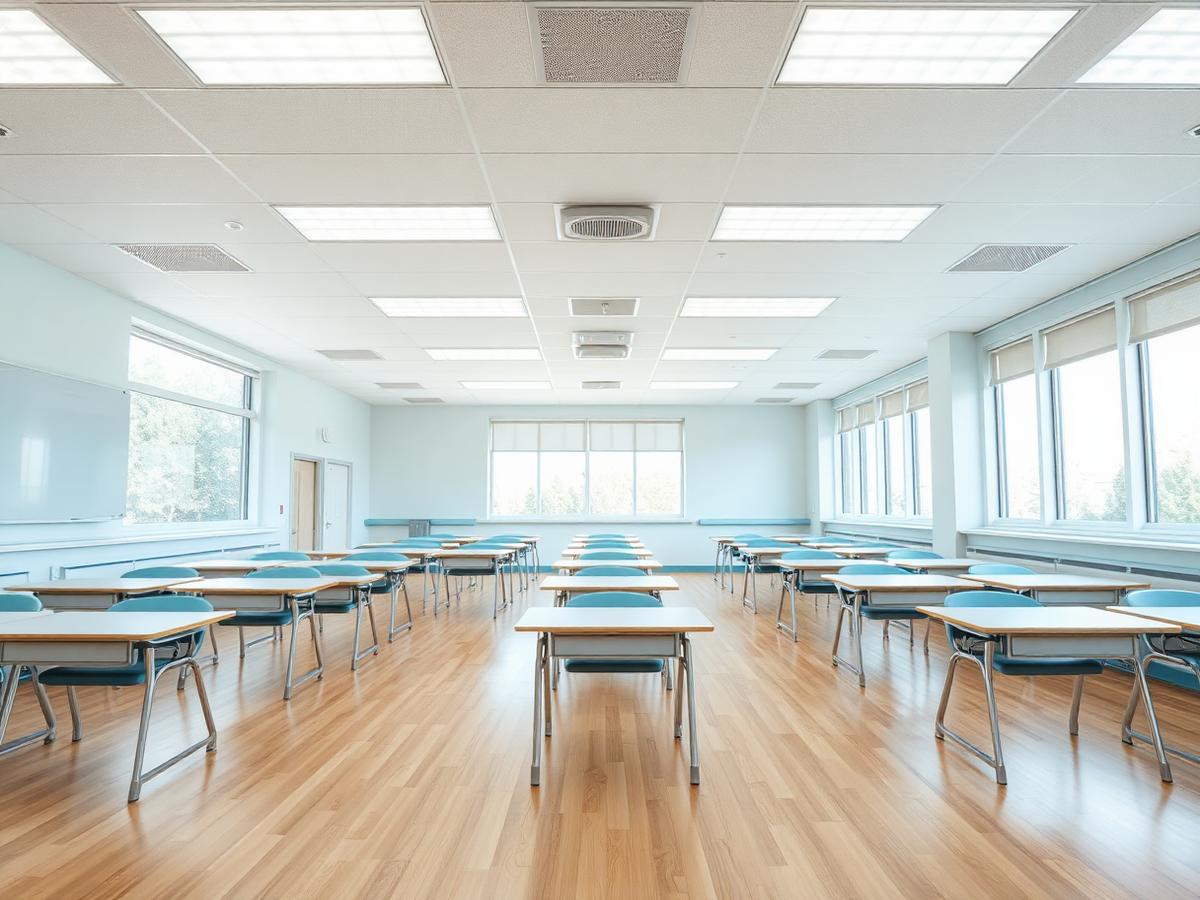
Assess what each classroom is actually getting
Start with a per-room inventory rather than a district average. Unit ventilators that were disabled, painted-over louvers, and rooms converted from storage all hide behind a building-level number.
- Is there a functioning outside-air supply, and is it running?
- What filter is installed, and when was it last changed?
- How many occupants share the room, and for how many consecutive hours?
- Is there any room-level air treatment at all?
Rank options by disruption, not by ideal
Ranking honestly is what turns a plan into a completed project.
- Mechanical replacement: highest impact, multi-year capital, summer-only windows
- Filter upgrades: fast and cheap, limited to air that reaches the unit, recurring cost
- Portable HEPA: immediate, but floor space, noise, and a permanent filter budget
- UV-C troffer retrofit: minutes per room, reuses the lighting grid, no consumables, includes an LED upgrade
Cost of ownership, honestly
Purchase price is the part districts compare and the part that matters least over ten years. Portable units carry filters, storage, and replacement churn; unit-ventilator work carries mechanical service. Sealed-chamber LED fixtures have no filter consumable and a source life measured in years, but they are a capital fixture purchase up front.
Whichever option a district picks, budget for verification — a plan that no one measures is indistinguishable from no plan a year later.
Communicating it to families
Parents ask two questions: is it safe, and does it run all the time? For sealed-chamber UV-C the answers are short — the germicidal light is fully enclosed inside the fixture, and air treatment runs whenever the room is in use, with nothing for a teacher to switch on.
Key takeaways
- Inventory air per classroom; district averages hide disabled ventilators and converted rooms.
- Rank improvements by disruption so the plan finishes before respiratory season.
- Compare ten-year ownership cost, not purchase price alone.
- Budget for verification and prepare plain-language answers for families.
K-12 Classroom Air Quality Guide
A one-page district guide: coverage per classroom, rollout scheduling around school breaks, and the talking points that carry a board vote.
- Fixture-count worksheet by classroom size
- Phased rollout calendar template
- Board-presentation talking points on absence and continuity
- UV-C troffers vs. portable HEPA cost-of-ownership comparison
Frequently asked questions
How can schools improve classroom air quality quickly?
The fastest structural change is usually the lighting grid: swapping existing 2x4 troffers for UV-C air-cleaning troffers adds continuous room-level air treatment in minutes per room, with no ductwork and no floor space lost.
Are UV-C fixtures better than portable HEPA units in classrooms?
They cover the same need differently. UV-C fixtures inactivate pathogens in the airstream, mount in the ceiling out of the way, and have no filter consumable; portable HEPA units capture particles but occupy floor area, add noise at classroom-scale airflow, and require ongoing filter purchases.
What should a district measure to prove it worked?
Set a baseline before deployment — delivered air changes per hour in representative rooms, plus whatever illness-absence data the district already tracks — then re-measure the same rooms with the same method after installation.